
This is the blog site for Bird Ladder & Equipment Co. serving contractors since 1954. Bird Ladder distributes high quality contractors equipment at low discounted prices. We are able to offer good shipping rates to US and Canadian customers. It is our goal to keep contractors updated on new items on the market that makes their job easier and safer. We also hope to be a source for safety information and OHSA updates. We also have links to sites with safety info and training.
Monday, August 22, 2016


Friday, September 25, 2015
Top 10 OSHA Violations
Take a look at the
most frequently cited OSHA regulations resulting from last year's inspections
of jobsites by federal OSHA. Even though many of these regulations don’t
correlate exactly with fall protection, highlighting them will hopefully shine
a light on the sheer volume of potentially harmful workplace actions that take
place every year. The combined
violations relating to fall protection make up for 16,207 of
the 40,560 total citations (that's almost 40%!), showing just
how focused OSHA is on ensuring the safety of those who work at heights.
Below are top
10 most frequently cited OSHA regulations:
1. FALL PROTECTION (OSHA STANDARD: 1926.500) - TOTAL #
OF VIOLATIONS: 7,516
This standard outlines
where fall protection is required, which systems should be used for given
situations, the proper construction and installation of safety systems, and the
proper supervision of employees to prevent falls. It is designed to protect employees
on walking/working surfaces with an unprotected side or edge above six feet.
2. HAZARD COMMUNICATION (OSHA STANDARD: 1920.1200) - TOTAL
# OF VIOLATIONS: 6,148
The purpose of this
section is to ensure that the hazards of all chemicals produced or imported are
clearly defined, and that information concerning these hazards is transmitted
to employers and employees. The requirements of this section are intended to be
consistent with the provisions of the United Nations Globally Harmonized System
of Classification and Labelling of Chemicals (GHS), Revision 3. The transmittal
of information is to be accomplished by means of comprehensive hazard
communication programs, which are to include container labeling and other forms
of warnings, safety data sheets, and employee training.
3. SCAFFOLDING (OSHA STANDARD: 1926.451) - TOTAL # OF
VIOLATIONS: 5,724
The very presence of
scaffolding at a jobsite can introduce hazards to a work environment, such as
falls, falling objects, and structural instability. OSHA’s scaffolding
requirements are performance-based, which means the rules aren’t as rigid as
other standards. The specifics of compliance depend on the types of scaffolding
used, the situations they are used in, and the personnel using them.
4. RESPIRATORY PROTECTION (OSHA STANDARD: 1910.134) - TOTAL
# OF VIOLATIONS: 3,843
This standard applies
to general industry, shipyards, marine terminals, long shoring, and
construction. It states that, in the control of occupational diseases caused by
breathing air contaminated with harmful dusts, fogs, fumes, mists, gases,
smokes, sprays, or vapors, the primary objective shall be to prevent
atmospheric contamination. This is accomplished by implementing accepted
engineering control measures. For example, enclosure or confinement of the operation, general and local ventilation, and substitution of less toxic materials. When
effective engineering controls are not feasible, or while they are being instituted,
appropriate respirators shall be used pursuant to this section.
5. POWERED INDUSTRIAL TRUCKS (OSHA STANDARD: 1910.178) - TOTAL
# OF VIOLATIONS: 3,147
This section contains
safety requirements relating to fire protection, design, maintenance, and use
of fork trucks, tractors, platform lift trucks, motorized hand trucks, and
other specialized industrial trucks powered by electric motors or internal
combustion engines. This section does not apply to compressed air or
nonflammable compressed gas-operated industrial trucks, to farm vehicles, or to
vehicles intended primarily for earth moving or over-the-road hauling.
6. LOCKOUT / TAGOUT (OSHA STANDARD: 1910.178) - TOTAL #
OF VIOLATIONS: 3,117
This covers the
servicing and maintenance of machines and equipment in which the unexpected
energization or startup of the machines or equipment, or release of stored
energy, could harm employees. This standard establishes minimum performance
requirements for the control of such hazardous energy.
7. LADDERS (OSHA STANDARD: 1926.1053) - TOTAL # OF
VIOLATIONS: 2,967
This standard states
that when portable ladders are used to access an upper landing surface, the
ladder side rails shall extend at least 3 feet above the upper landing surface
to which the ladder is used to gain access; or, when such an extension is not
possible because of the ladder's length, then the ladder shall be secured at
its top to a rigid support that will not deflect, and a grasping device, such
as a grab rail, shall be provided to assist employees in mounting and dismounting
the ladder. In no case shall the extension be such that ladder deflection under
a load would, by itself, cause the ladder to slip off its support.
8. ELECTRICAL, WIRING METHODS, COMPONENTS, AND EQUIPMENT (OSHA
STANDARD: 1910.305) - TOTAL # OF VIOLATIONS: 2,907
The basic aspects of
this standard include:
1. Electrical continuity of metal raceways and
enclosures. Metal raceways,
cable armor, and other metal enclosures for conductors shall be metallically
joined together into a continuous electric conductor and shall be so connected
to all boxes, fittings, and cabinets as to provide effective electrical
continuity.
2. Wiring in ducts. No wiring systems of any type shall be
installed in ducts used to transport dust, loose stock or flammable vapors. No
wiring system of any type may be installed in any duct used for vapor removal or for ventilation of
commercial-type cooking equipment, or in any shaft containing only such ducts.
3. Temporary wiring. Temporary electrical power and lighting
wiring methods may be of a class less than would be required for a permanent
installation. Except as specifically modified in this paragraph, all other
requirements of this subpart for permanent wiring shall apply to temporary
wiring installations.
9. MACHINERY AND MACHINE GUARDING (OSHA STANDARD: 1910.212) - TOTAL
# OF VIOLATIONS: 2,520
This standard
identifies types of guarding and when it is needed. In short, it states that
one or more methods of machine guarding shall be provided to protect the
operator and other employees in the machine area from hazards such as those
created by point of operation, ingoing nip points, rotating parts, flying
chips, and sparks. Examples of guarding methods are -barrier guards, two-hand
tripping devices, electronic safety devices, etc.
10. ELECTRICAL SYSTEMS DESIGN, GENERAL REQUIREMENTS (OSHA
STANDARD: 1910.303) - TOTAL # OF VIOLATIONS: 2,427
This standard covers
the examination, installation, and use of electrical equipment, electrical
connections, arcing parts, marking, disconnecting means and circuits, and
minimum space around electrical equipment.
It is vital that both
employers and workers understand the importance of complying with OSHA
regulations. Understanding and satisfying these regulations will ensure a safe
jobsite, protect the work force, and save lives.
Wednesday, December 10, 2014
Maintaining Workplace Safety with Construction Trash Chutes
The U.S. Occupational Safety and Health Administration (OSHA) is responsible for providing and enforcing guidelines for workplace safety. According to OSHA, construction trash chutes offer a safe and convenient way to remove debris and waste materials from rooftops and elevated areas. OSHA regulations require the use of trash chutes when dropping trash from roofs over 20 feet in height. These chutes must be secured to the building to ensure optimal safety for construction workers and others in the working area. The lineup of construction trash chute packages offered by Bird Ladder and Equipment Company is designed to comply with all applicable OSHA standards and provides real help for workers in managing waste disposal tasks in the working environment.

Safe Use of Construction Trash Chutes
Proper installation of trash chutes is critical to ensure the safety of workers and to prevent accidents caused by falling debris. Trash chutes are available in a wide range of diameters and lengths; modular chutes can be combined to ensure the right size for the job. Smaller chutes can often be attached securely to the side of the building. Larger chutes may require a supporting frame to ensure that they stay securely in place when in use. OSHA requires that 42-inch guardrails be installed around the top opening of construction trash chutes to prevent workers from falling into the opening during the course of their duties. These rail guards must be securely anchored to stay in place even when subjected to severe impacts or sustained pressure.
Clearing the Path Below
A perimeter should be enforced around the landing spot for trash on the ground floor. In some cases, the materials removed from upper levels of the building can land with considerable force. Ensuring that workers keep a safe distance from the area where trash will land can prevent serious injuries in the workplace environment and can ensure full compliance with all OSHA regulations governing the use of construction trash chutes in the working environment.
Construction trash chutes can significantly speed the clean-up process and can remove obstacles that can present risks to workers on rooftops or in elevated areas of the worksite. By allowing the fast and convenient disposal of unneeded materials and construction debris, trash chutes can enhance productivity and improve morale among the work crew. Polyethylene trash chutes offer a solid combination of durability and lightweight performance to ensure the most effective and convenient solutions for construction firms and building maintenance companies. By working with an established supplier like Bird Ladder and Equipment, project managers and crew leaders can enjoy increased productivity and improved compliance with all applicable OSHA regulations.
Tuesday, April 15, 2014
Bird Ladder Open House May 15th.
Bird Ladder will be having their annual open house May 15th. Every year we have customer appreciation day which includes a truck load sale on everything. Werner ladders, pumpjacks, planks, Granite scaffolding, MBW compactors, trowels and mixers, Werner fall protection, Acro roofing equipment, Tie down shingle hoists, Vanmark brakes, Knaack job boxes, Weatherguard truck and van equipment, Reechcraft powerpole, powermast and powerlift to name a few.
We will also have factory reps demonstrating their products. We will be introducing new products at the show. The NEW Knaack 118 data vault will be on display with demonstrations. We will also have the new Reechcraft Powermast set up. They also have a new free standing base that will be shown. We will also have new MBW plate compactors on display.
Free safety classes will also be returning this year. We will offer ladder safety courses, fall protection courses and also a presentation by Acro products on use of their roof edge protection. cards will be issued for the lader and fall protection training. We are also attempting to have a representative from OSHA here to answer question.
We also serve lunch from 12:00 till the food runs out. So bring your shopping list, save money, get trained, and have lunch.
Thursday, March 20, 2014

OSHA will conduct a national safety stand-down June 2-6 to raise awareness among construction employers and their workers about the hazards of falls, the leading cause of fatal incidents for the industry.
OSHA is seeking partners for the stand-down, and it has stocked a national safety stand-down website with information about how to conduct a successful stand-down. After it takes place, employers will be able to provide feedback and receive a personalized certificate of participation.
An OH&S webinar on April 3 is another way to get information about preventing construction falls. Three experts from OSHA (Jim Maddux, Directorate of Construction director); NIOSH (Dr. Christine Branche, Office of Construction Safety and Health director); and CPWR—The Center for Construction Research and Training (Pete Stafford, executive director) will discuss OSHA’s ongoing Fall Prevention Campaign and the latest information about the causes of falls in the U.S. construction industry.
"Falls account for more than a third of all deaths in this industry," said Dr. David Michaels, the OSHA assistant secretary. "We're working with employers, workers, industry groups, state OSH plans, and civic and faith-based organizations to host safety stand-downs that focus on recognizing hazards and preventing falls. We are getting the message out to America’s employers that safety pays and falls cost."
The stand-down is part of OSHA's ongoing Fall Prevention Campaign, which was started in 2012 and was developed in partnership with the National Institute for Occupational Safety and Health and NIOSH's National Occupational Research Agenda program.
"We are pleased to join again with OSHA and our NORA partners to focus on fall prevention at construction sites," said NIOSH Director Dr. John Howard. "Preventing falls in the construction industry benefits everyone, from the worker, to the employer, to the community at large. This safety stand-down serves as an important opportunity for everyone to take the time to learn how to recognize and prevent fall hazards."
Thursday, March 13, 2014
Weatherguard Van Solutions
WernerCo Introduces New Weather Guard OEM Van Solutions
Range includes Ford Transit Connect, Ram ProMaster, Mercedes Sprinter and others.

WernerCo announces the introduction of professional trade packages for commercial van OEM’s (Original Equipment Manufacturer), including the Ram ProMaster, the Mercedes Sprinter, Ford Transit Connect and others.
Designed for contractors and remodelers on the move, the Weather Guard OEM trade packages provide secure, durable and organized van solutions for professionals, regardless of the vehicle. The custom designed Weather Guard Van solutions are developed to fit every detail, including the contours of specialty vans, such as the Ram ProMaster.
“We have expanded our offering to provide Weather Guard storage solutions for a range of vehicle manufacturers because we know a one-size-fits-all approach isn’t always best”, said Jeff Kotz, Senior Van Product Manager from WernerCo. “Among our offerings, we are excited to have several for Ford and will continue to develop customized van and truck solutions for new vehicle models as they are introduced. Our goal is to continue to provide professional tradesmen with solutions that secure their tools and materials, while maximizing productivity.”
Customizable Van Solutions That Are Easy to Install
The Weather Guard Van storage solutions feature custom bulkhead, space-maximizing design, and a wide range of shelving and accessory options to accommodate any type of trade business—from general contractors to plumbing and Mechanical/ HVAC. With ready-to install accessories and pre-drilled holes, Weather Guard installs quickly and allows for customizations.
The Weather Guard Van storage solutions feature custom bulkhead, space-maximizing design, and a wide range of shelving and accessory options to accommodate any type of trade business—from general contractors to plumbing and Mechanical/ HVAC. With ready-to install accessories and pre-drilled holes, Weather Guard installs quickly and allows for customizations.
The storage solutions and accessories provide flexibility and convenience while the ladder and roof rack options make loading and unloading oversized equipment or supplies easy and secure. Weather Guard now offers a full range of professional trade packages for all commercial van OEM’s from the New Ford Transit Connect and RAM Promaster to the Ford E-Series, Chevy Express/GMC Savana, Nissan NV and the Mercedes Sprinter.
Each custom designed Weather Guard Van Storage solution includes:
- Better Bulkheads: The Bulkhead for the 2014 Transit Connect and Promaster vans provide maximum protection for drivers and passengers against shifting loads in the cargo area and allow for unobstructed visibility of the cargo, side door and rear door areas.
- REDZONE Van Shelving: The shelving systems come in popular sizes with two, three or four shelves and make it easy to create custom configurations. The secure storage shelf and door modules maximize efficiency and security. End panels and single shelves complete the system and are packaged separately.
- Drawer & Bin Cabinets: High quality, durable drawer cabinets feature latches for each drawer, smooth ball-bearing rollers and secure locks that can be keyed alike. Bin cabinets feature hook and loop fasteners to securely hold bins in place.
- REDZONE Accessories: Keep frequently used tools and materials close—including a tool organizer, cleaning station, bucket and tank holders, caulk tube tray and a range of trade-specific accessories.
- Quick Installation: Features floor mounting brackets, simplified bulkhead mounting brackets and pre-punched mounting holes in end panels and shelves.
- Specialty Storage: Includes new secure storage locking cabinets and drawers, including the PACK RAT Drawer Units, lightweight and stackable ITEMIZER Drawer Units, or the BED RAT Sliding Platform.
Thursday, February 27, 2014
Friday, January 17, 2014
Job Site Trash Chutes
A risky part of the construction industry is the demolition of the old that makes way for the new. There are multiple hazards in renovating old buildings that are not as inherent for new construction. Both have their hazards, but tearing out old materials in partial and full remodeling jobs has hazards in the debris produced during the demolition phase.
Construction Site Cleanup
For a safe workplace, it is a good idea to assign personnel to continually gather and remove debris from active work areas. As demolition debris collects, the hazards of workers tripping, falling and being cut by sharp debris increases. Any floor above the first floor involves using stairs or service elevators for debris removal unless a construction trash chute is installed.
The standard tools of cleanup at a construction site are still used. Wheelbarrows, shovels, brooms and buckets help in collecting the debris. The savings in time and labor come from not needing to descend and climb stairs or wait on an elevator to take loads of debris to ground level where the construction trash dumpster is located. Also, using a construction trash chute eliminates the need to hoist materials up and into a dumpster. Items are directed straight into dumpsters at the terminating end of the chute.
The standard tools of cleanup at a construction site are still used. Wheelbarrows, shovels, brooms and buckets help in collecting the debris. The savings in time and labor come from not needing to descend and climb stairs or wait on an elevator to take loads of debris to ground level where the construction trash dumpster is located. Also, using a construction trash chute eliminates the need to hoist materials up and into a dumpster. Items are directed straight into dumpsters at the terminating end of the chute.
Trash Chute Benefits
Worker fatigue of carrying bags, boxes and buckets of debris to the dumpster outside is eliminated. The potential of falling while carrying heavy debris down flights of stairs is eliminated. No workers need to lift heavy items over their heads to deposit them into dumpsters at ground level. After a short period of time is spent installing the chute at a window, debris removal is unimpeded. The chute can be easily extended to cover all floors under construction.
Trash Chute Capabilities
Quality trash chute packages sold by the Bird Ladder and Equipment Company can handle solid or liquid waste. Outriggers can easily be installed at a vertical bank of windows to serve all floors under construction above one dumpster. Outriggers can be connected to windows as small as 36 inches. A lifting winch makes easy and quick installation of the largest and heaviest trash chutes. Intake hoppers that receive debris are made of 12 gauge steel for long lasting durability.
Trash chute installation at a construction site makes removal of demolition debris and construction waste easy and safe. Just shovel, toss or empty debris and waste into the intake hoppers, and the materials slide down the chute right into the dumpster at ground level. No bagging, boxing or toting items down stairs or elevators is needed. They increase productivity by allowing less time needed to be involved in cleanup of construction sites. The short period of time needed to install a chute saves countless hours that would otherwise be used in getting demolition debris and construction waste to ground level.
Knaack 4830D
Knaack has developed the first and only job-site Knaack 4830-D with independent locking draw. It has many features which include:
- Anti-Slam Lid- Gas strut supported lid to control closing speed
- Raised Chest Floor- Easily reach chest bottom without over-reaching
- 3 Sided easy grip lid-Continuous ergonomic grip for easy access
- Independent Watchman IV locks- Separate locking system for chest and drawer.
Junk Trunk quick access drawer- Quickly access high demand tools.
- 4830-d Box
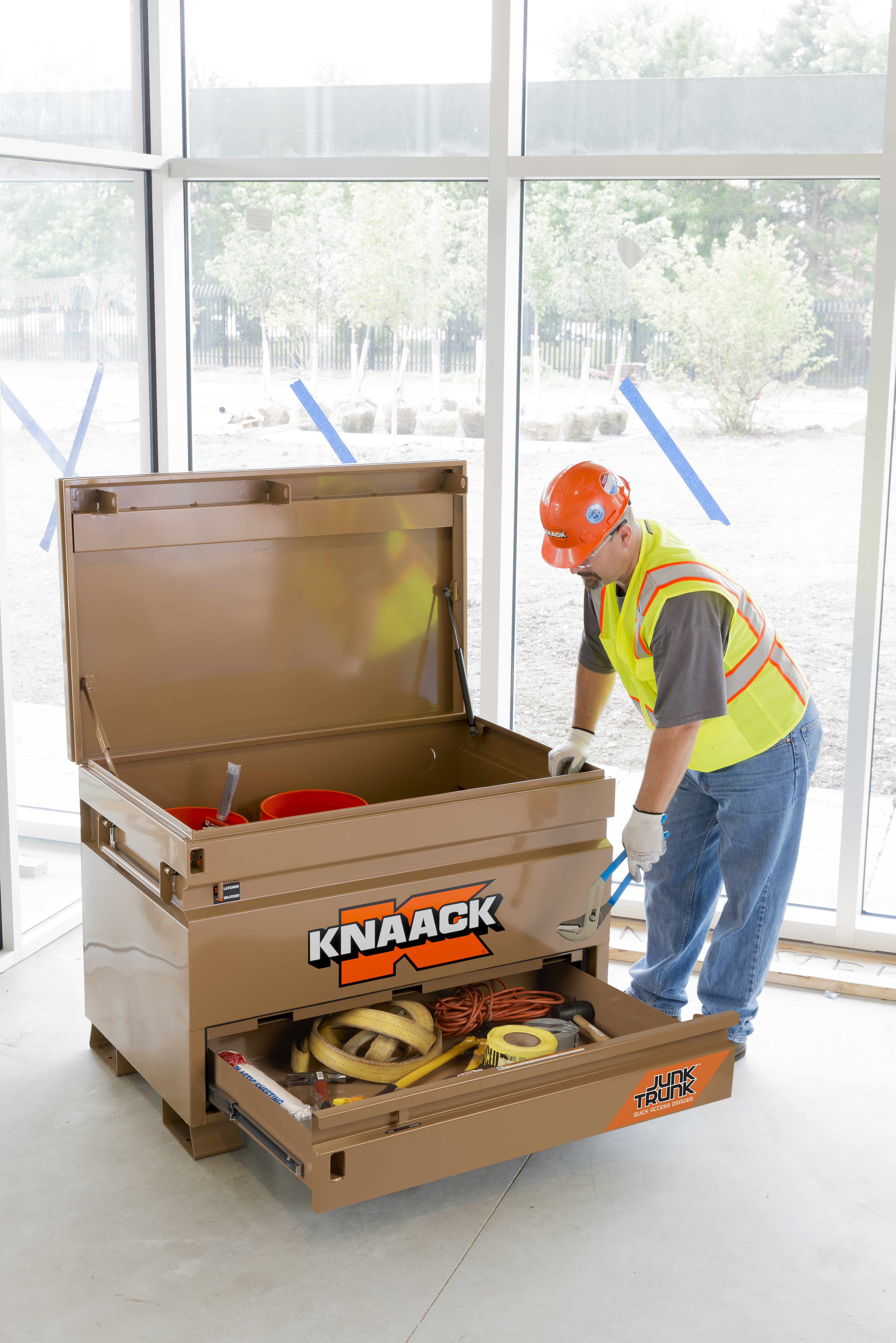
- Weight: 254 lbs.
- 48" x 30" x 35" closed
Knaack has hit a home run with this box. The draw capacity is rated at 150 lbs.
Werner Podium Ladder
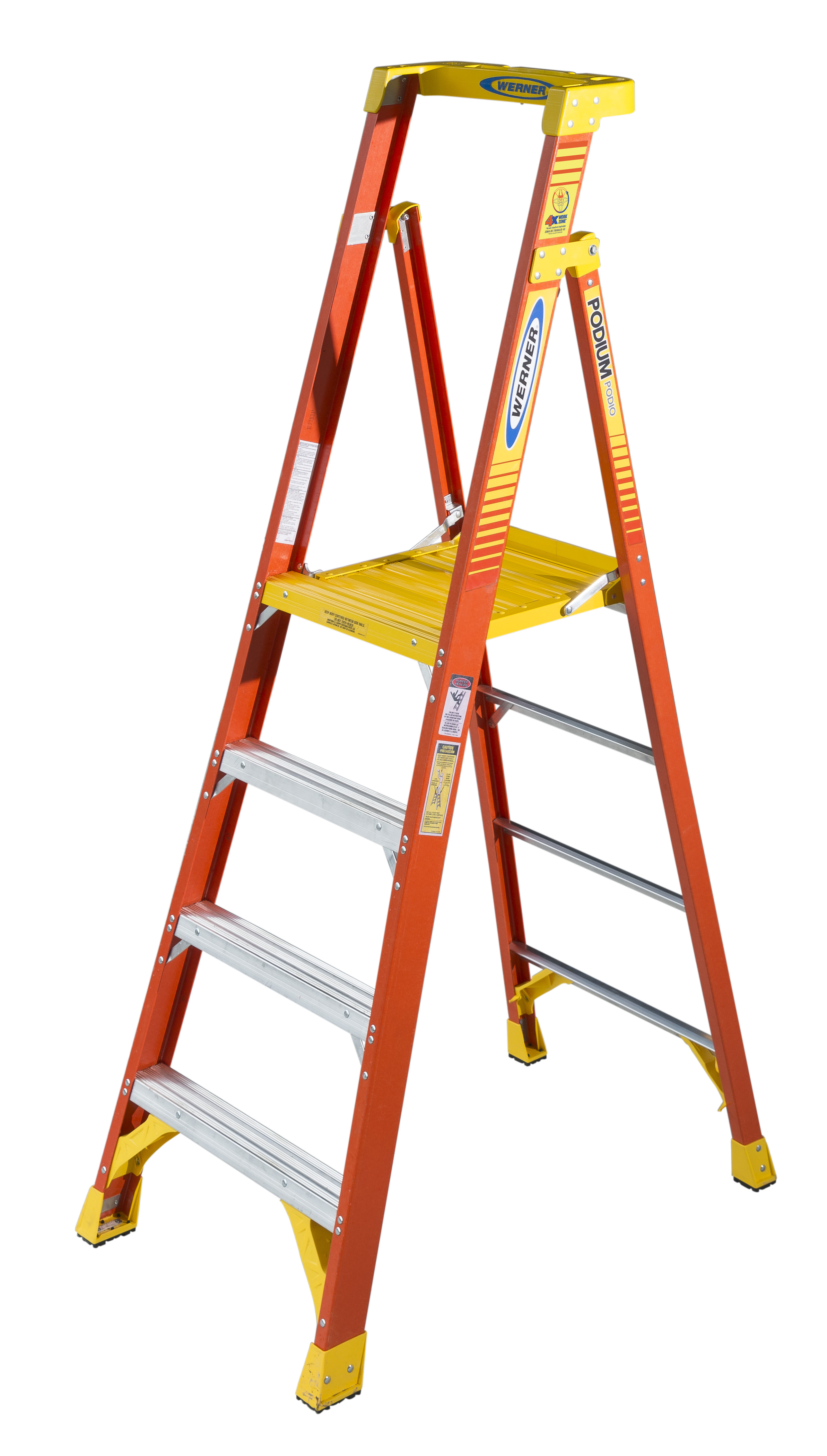
WernerCo. has introduced a new platform ladder called the Podium which is ideal for working at fixed heights and is designed to provide a full range of motion while providing protection at every angle.
The Podium ladder uses the LOCKTOP™ design which organizes tools at the top of the ladder which also functions as an integrated waist-high guard rail that securely wraps around the work zone. The ladder also features the EDGE360™ bracing system that gives protection from every angle on the over-sized platform which allows four times the work zone then a standard ladder.
Mark Peters, Director of Marketing at WernerCo. stated that "We designed our new Podium Ladder to help prevent misuse and falls. While safety is the most important feature, we also know that comfort, mobility and access are important to our customers who have to stand on a ladder for extended periods of time. The new Podium Ladder includes an actual standing platform vs. a traditional ladder step that allows for increased reach and range of motion. The best part, it feels like the user is standing on the ground instead of on a ladder.”
The Podium ladder is also equipped with a full set of rear horizontals, full aluminum bracing and is manufactured with seven-layer fiberglass construction. The Podium has a 300lb load capacity which includes user and materials and has a Type 1A duty rating.
American made compaction plates
MBW is one of the last remaining American made manufacturer of compaction plates. To remain competitive, they have upgraded there manufacturing equipment to help them remain competitive in a market where other manufacturers have gone off shore to manufacture their equipment. Here is a link to a list of the equipment they are presently using in the manufacture of their equipment.
Since 1967, MBW has been manufacturing one of the construction industry's most interesting lines of compaction, concrete and related equipment.
What makes the MBW line interesting? MBW is not a copyist - we do not simply duplicate designs developed by others. MBW begins each new engineering project with the assumption that significant progress can be made in terms of improved productivity, reduced maintenance, longer life, enhanced user safety or lower long-term cost of ownership. Often, MBW's R&D efforts result in entirely fresh approaches to solving industry problems. Many of our products have pushed the productivity envelope to new heights. Some MBW products afford their operators the industry's safest tools in a given product class. Most MBW products solve long standing maintenance issues and extend product life expectations. Our goal is to provide equipment users with products of significant, tangible, comparative value... reasons to invest in MBW products.
Recently they have introduced a new line of compact plates called the GPX series.
This series of economical vibratory plates, the GP12, GP15 & GP18, are portable, and offer outstanding compaction performance. A patent-pending suspension system that places shock mounts in a predominantly shear mode at the high amplitude front end of the plate and a predominantly compressive mode at the low amplitude trailing end of the plate. This system reduces hand arm vibration and also better isolates all upper mass components, including the engine, from vibrations produced by the machine's exciter. With amplitudes up to .058 inches, centrifugal force up to 2100 lbf and travel speed to 75 feet per minute these plates are ideal in confined areas of granular soils including sands, bank run, gravels and capable of achieving lift depths of up to 10 inches (25 cm).
These lightweight plates weighing 129 lbs (59 kg) to 143 lbs (65 kg) are easy to lift and maneuver about the jobsite. Accompanied by intense vibration this series of plates are ideally suited as an economical alternative for small to medium soil compaction applications.
- MBW GP18 plate compactor
Thursday, December 20, 2012
OSHA Update -
"Construction" or "Maintenance," What OSHA Standards Apply?
I found the following article in the Contractor Supply web site and thought you might be interested.
Most OSHA guidelines are pretty clear: this distinction isn't.
In most cases, deciding what OSHA standard applies to the work in question is straight forward. When it comes to deciding whether certain work is "construction," subject to OSHA's Construction Standards, or "maintenance," subject to OSHA's General Industry Standards, however, the answer is not always so clear. A new OSHA Directive on Highway Construction Work Zones, CPL 02-01-054, issued in October 2012, offers some new insights on how to answer this question.[1]
Correctly deciding whether particular work comes under OSHA's Construction or General Industry Standards is essential to an employer's efforts to assure compliance and its ability to limit its legal liability. While some OSHA safety and health requirements are identical under both the Construction and General Industry Standards - Hazard Communication is one example - many are very different. For instance, OSHA's recent Crane and Derrick rule issued in 2010 applies to cranes used in construction work, but not when the same equipment is used in general industry work.
Correctly deciding whether particular work comes under OSHA's Construction or General Industry Standards is essential to an employer's efforts to assure compliance and its ability to limit its legal liability. While some OSHA safety and health requirements are identical under both the Construction and General Industry Standards - Hazard Communication is one example - many are very different. For instance, OSHA's recent Crane and Derrick rule issued in 2010 applies to cranes used in construction work, but not when the same equipment is used in general industry work.
Another area where the standards differ depending upon the type of work involved is confined spaces. If the work is considered "maintenance," confined space entries are extensively regulated by OSHA's General Industry Permit-Required-Confined-Space Standard, 29 C.F.R. § 1910.146. If, on the other hand, the job is considered "construction," only minimal training requirements for confined space entries apply. 29 C.F.R. § 1926.21(b)(6).[2]
Many other OSHA requirements -- including fall protection and work zone protection -- significantly differ depending on whether the General Industry or Construction Standards apply.
Click here to read the entire article.
Source: jdsupra.com
Wednesday, December 12, 2012
OSHA Extends Temporary Enforcement Measures for Residential Construction Into 2013
The U.S. Department of Labor's Occupational Safety and Health Administration will extend for three months its temporary enforcement measures in residential construction. The temporary enforcement measures, now extended through March 15, 2013, include priority free on-site compliance assistance, penalty reductions, extended abatement dates, measures to ensure consistency and increased outreach.
OSHA has been working closely with the industry to assist employers in complying with the new directive. From October 1, 2011 to September 30, 2012, OSHA's On-site Consultation Projects performed more than 3,000 on-site visits, conducted close to 1,100 training sessions and delivered close to 500 presentations related to fall protection in residential construction. OSHA’s regional and area offices also conducted more than 1,200 outreach activities on the directive. The agency will continue to work with employers to ensure a clear understanding of, and to facilitate compliance with, the new policy.
OSHA will also continue to develop materials to assist the industry, including a wide variety of educational and training materials to assist employers with compliance for residential construction and theFall Prevention Campaign.
Monday, November 26, 2012
THREE SIMPLE STEPS TO PREVENT FALLS
Plan, Provide, Train
OSHA has a new program to help contractors eliminate falls. It supplies contractors with tools to prevent different types of falls. It is a partnership program with the National Institute for Occupational Safety and Health (NIOSH) and The National Occupational Research Agenda (NORA). Please use this as a tool in your safety program.
Friday, October 19, 2012
OSHA
moves residential roof transition date to December 15, 2012
The residential roofing industry has seen several changes since June 2011,
when OSHA rescinded its directive for residential fall protection requirements. Several deadlines have seemingly come and gone adding to the confusion regarding when those working at heights within residential construction needed to be in compliance with OHSA’s new guidelines.
The new requirements within the residential fall protection directive
STD 03-11-002 remain in effect, meaning employers must move to adopt these new requirement, OSHA has implemented a transition period for temporary enforcement measures for 19 months until December 15, 2012 which include on-site compliance assistance, penalty reduction, extended abatement dates and increased outreach programs in an attempt to educate the residential construction industry of these new requirements.
Monday, September 24, 2012
Construction Fatalities Decrease in 2011
According to the Bureau Of Labor Statistics, fatal work injuries were down in 2011. An interesting note is that fatal work injuries in the private construction sector declined to 721 in 2011 from 774 in 2011. This is a decline of 7% and the fifth consecutive year of lower fatality counts. Fatal construction injuries are down nearly 42% since 2006. However, even with the number of fatalities declining, construction still accounted for the second most fatal work injuries of any industry sector in 2011. Falls, slips or trips resulted in 666 worker deaths in 2011, about 14 percent of all fatal work injuries. Falls, slips and trips were the cause of 35 percent of workplace fatalities in the construction industry. Struck by accidents caused a total of 472 worker fatalities and made up 10 percent of construction industry deaths in 2011. To see the complete article http://www.bls.gov/news.release/cfoi.nr0.htm.
Friday, September 21, 2012
OSHA Fines Staten Island Contractor $136,000 For Fall Hazards
Below is an article I found in ForConstructionpros.com. If you can follow the link to the citation. Notice the the fine for missing braces($ 5390.00), missing guard rail ( $ 3850.00), improper training
($ 5390.00), improper ladder usage ($ 3080.00). All of these items are covered when you take our ladder safety and hazard awareness course.
The U.S. Department of Labor's Occupational Safety and Health Administration (OSHA) has cited Blade Contracting Inc., based in Staten Island, N.Y., with seven safety – including one willful – violations for fall hazards at a Jersey City, N.J., worksite. The investigation was initiated after a worker with the masonry contractor was injured by falling from a sixth floor balcony while attempting to access a suspension scaffold. Proposed penalties total $136,290.
The willful violation reflects the use of makeshift devices on top of scaffolds to increase the level height for working and a failure to protect workers on scaffolds from fall hazards. A willful violation is one committed with intentional knowledge or voluntary disregard for the law's requirements or with plain indifference to worker safety and health.
Two repeat violations involve unprotected workers on scaffolds and a sixth floor balcony. A repeat violation exists when an employer previously has been cited for the same or a similar violation of a standard, regulation, rule or order at any other facility in federal enforcement states within the last five years. The same violations were cited in 2007 and 2010.
Four serious violations involve a failure to install cross bracing on the entire scaffold, ensure personal fall arrest systems were attached to a secure anchorage point and not scaffold guard rails, train workers to recognize and avoid hazards including falls, and ensure proper step ladder use. A serious violation occurs when there is substantial probability that death or serious physical harm could result from a hazard about which the employer knew or should have known.
The citations can be viewed at:http://www.osha.gov/ooc/citations/BladeContracting_331283_0914_12.pdf*.
The company has 15 business days from receipt of the citations to comply, request an informal conference with the OSHA area director or contest the citations and proposed penalties before the independent Occupational Safety and Health Review Commission.
The willful violation reflects the use of makeshift devices on top of scaffolds to increase the level height for working and a failure to protect workers on scaffolds from fall hazards. A willful violation is one committed with intentional knowledge or voluntary disregard for the law's requirements or with plain indifference to worker safety and health.
Two repeat violations involve unprotected workers on scaffolds and a sixth floor balcony. A repeat violation exists when an employer previously has been cited for the same or a similar violation of a standard, regulation, rule or order at any other facility in federal enforcement states within the last five years. The same violations were cited in 2007 and 2010.
Four serious violations involve a failure to install cross bracing on the entire scaffold, ensure personal fall arrest systems were attached to a secure anchorage point and not scaffold guard rails, train workers to recognize and avoid hazards including falls, and ensure proper step ladder use. A serious violation occurs when there is substantial probability that death or serious physical harm could result from a hazard about which the employer knew or should have known.
The citations can be viewed at:http://www.osha.gov/ooc/citations/BladeContracting_331283_0914_12.pdf*.
The company has 15 business days from receipt of the citations to comply, request an informal conference with the OSHA area director or contest the citations and proposed penalties before the independent Occupational Safety and Health Review Commission.
Monday, September 17, 2012

OSHA and NSC renew alliance to address fall prevention
The Occupational Safety and Health Administration (OSHA) renewed its alliance with the National Safety Council (NSC) to continue enhancing worker safety and health by addressing construction hazards, injury and illness prevention programs and motor vehicle safety.
“Our continued alliance with NSC will focus on, among other things, preventing worker injuries and fatalities from falls in construction,” said David Michaels, assistant secretary of labor for Occupational Safety and Health. “Falls cause more fatalities than any other hazard in the construction industry. We look forward to collaborating with the NSC to educate and train employers and workers on preventing job hazards.”
During the two-year agreement, the alliance will develop fact sheets on the benefits of employers establishing an injury and illness prevention program, hazard identification and control topics that should be included in worker training, fall prevention and best practices for reporting near misses. The alliance also will develop a case study on preventing falls from heights in construction, focusing on the causes of fall protection failures and how employers can assure an effective and reliable fall prevention program.
NSC is a nonprofit, public service organization, founded in 1913, that offers training, educational programs and materials, consulting and advocacy on various safety and health topics. The organization represents 14,000 employers and more than six million workers employed by NSC members.
Through its alliance program, OSHA works with unions, consulates, trade and professional organizations, faith- and community-based organizations, businesses and educational institutions to prevent workplace fatalities, injuries and illnesses. The purpose of each alliance is to develop compliance assistance tools and resources, and educate workers and employers about their rights and responsibilities. Alliance program participants do not receive exemptions from OSHA inspections or any other enforcement benefits. For more information, visitosha.gov/dcsp/alliances/index.html.
Under the Occupational Safety and Health Act of 1970, employers are responsible for providing safe and healthful workplaces for their employees. OSHA's role is to ensure these conditions for America's working men and women by setting and enforcing standards, and providing training, education and assistance. For more information, visit osha.gov.
|
Friday, August 31, 2012
OSHA Residential Construction
The U.S. Department of Labor's Occupational Safety and Health Administration (OSHA) will extend for three months its temporary enforcement measures in residential construction through December 15, 2012. The temporary enforcement measures include priority free on-site compliance assistance, penalty reductions, extended abatement dates, measures to ensure consistency, and increased outreach.
OSHA has been working closely with the industry to assist employers in complying with the new directive. Since October 1, 2011, OSHA's On-site Consultation Projects performed more than 2,500 on-site visits, conducted 925 training sessions and delivered 438 presentations related to fall protection in residential construction. OSHA’s regional and area offices also conducted more than 800 outreach activities on the directive. The Agency will continue to work with employers to ensure a clear understanding of, and to facilitate compliance with, the new policy.
OSHA will also continue to develop materials to assist the industry, including a wide variety of educational and training materials to assist employers with compliance, which are available on the Web pages for residential construction and the Fall Prevention Campaign.
Monday, August 27, 2012
Safety Training


I found this new web site http://stopconstructionfalls.com that may be of interest to you. This new fall prevention campaign will focus on prevention and training relating to falls from roof, ladders and scaffolding on construction jobsites. It has many training tools and resources for you to use. Please check it out.
Subscribe to:
Posts (Atom)